

Start with what people search for
To do market research for a small business, find out what people are actually searching for, check when they search, and only then decide what to promote.
Surveys and focus groups have their place, but a search box is about the most honest research tool going.
Nobody types into Google to be polite.
I’ve built a report that does this for you, the Market Demand & Marketing Plan, and I’ll explain what’s in it further down.
First, here’s how to start on your own.
Before you spend on ads, check that people are actually searching for what you sell.
How do you find out what customers actually want?
Start with the words, not the products
List what you offer, then write down what a customer would type into Google to find it.
Not your name for it, theirs. A landscaper might call it “outdoor living solutions”.
Customers type “lawn mowing” and “hedge trimming”.
Check how many people in New Zealand search for each of those phrases
Google’s free Keyword Planner and Google Trends both give you a feel for this.
Expect modest numbers. New Zealand is a small country, so a phrase with a few hundred searches a month can still be a perfectly good one.
A phrase with real searches beats a product with none.
Look at what you already have
Google Search Console shows you the searches people used to find your website, and Google Analytics shows what they did once they arrived.
Between them you’ll often spot demand you didn’t know you had.
How do you check if there is demand for a product?
Look for three things.
- People search for it at all.
- The searches are steady or rising, not falling year after year.
- It isn’t only busy for two weeks of the year, unless you’ve planned for exactly that.
If you can’t find anyone searching for what you sell, that doesn’t prove nobody wants it.
People might not know what to call it yet. But it does tell you that advertising it will be hard work, because nobody is looking.
I’d rather you find that out before you’ve paid for the ads than after.
When do people search for what you sell?
Most businesses have busy and quiet times. But customers start searching before the busy time starts.
New pages can take weeks to a few months to show up in Google, and ads need two to three weeks to settle.
So if you wait until the rush arrives to update your website and switch on ads, you’re already late.
To check this yourself, look at your phrases in Google Trends across the last three years and note which months climb.
If the same months rise every year, you’ve found a pattern you can plan around.
If a bump only showed up once, treat it with suspicion. It might have been a one-off.
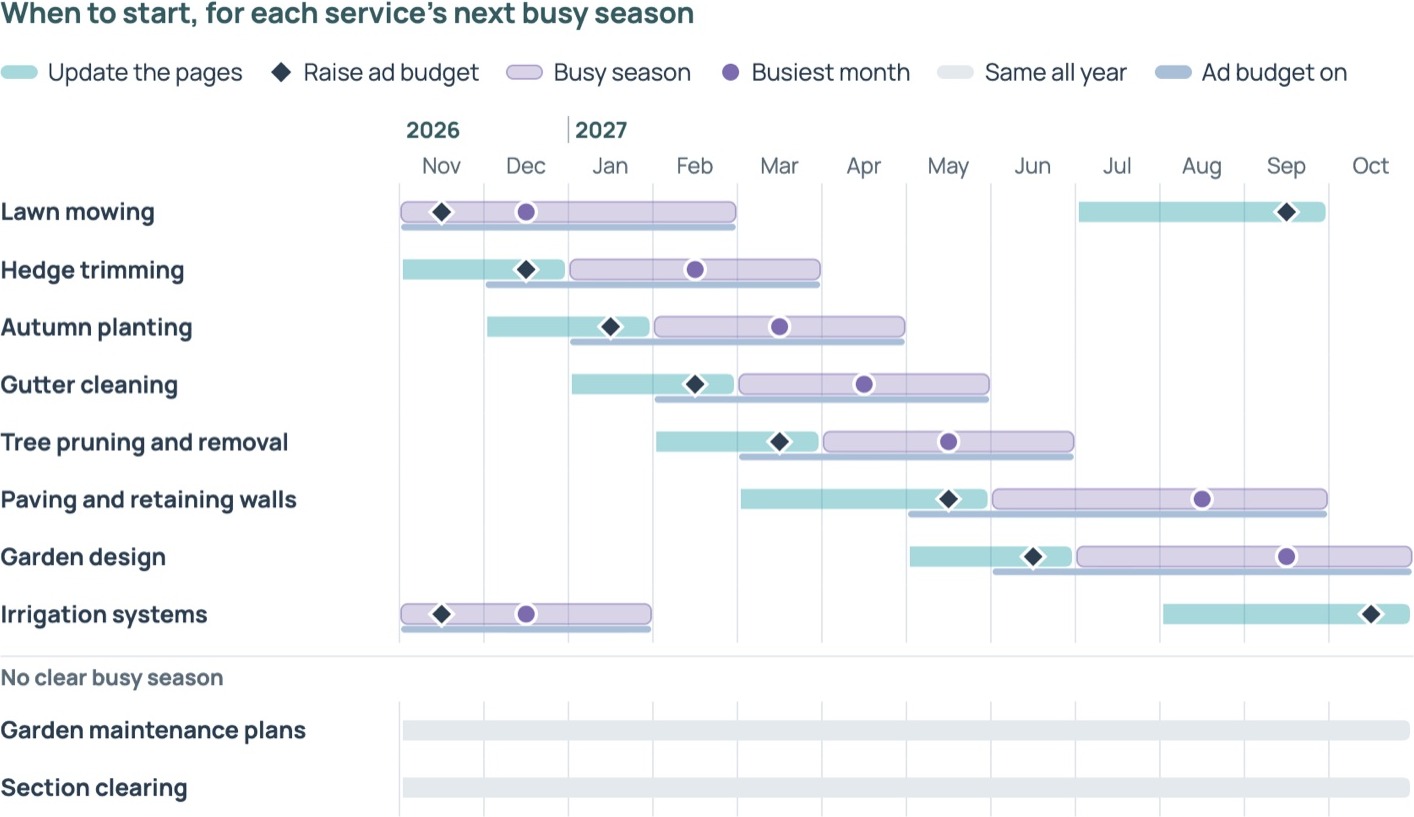
Each bar shows when to update the pages (green), when the busy season runs (purple) and the month to raise the ad budget (diamond).
What should you do with the numbers?
Turn them into a calendar. For each product or service, write down when searches start rising, then work backwards: when do the pages need updating, and when do ads need to go on?
A marketing plan is simply what to do, in what order, and by when.
You don’t need a 40-page template to write a marketing plan.
Then decide where your effort goes. For some things that’s your website pages.
For others it’s Google ads, your Google Maps listing, or emails and social posts before the busy season.
And if ads aren’t worth it for a particular product yet, say so and keep the money.
How to do market research using real Google data
I use four sources of real numbers, all from Google.
- Google search trends tell you when to do things.
- Search Console tells you what people search to find you.
- Analytics tells you what they do on your site.
- Google Ads can fill the gaps, by showing you searches you aren’t reaching yet.
Most of my clients didn’t know reports like this existed. Planning from real search data beats guessing.
There’s no point advertising and wasting budget on product lines that don’t match what people want to look at or find.
I wanted better forecasting, so a business can plan what to target through the year instead of finding out in the middle of the busy season that it started too late.
What do you get in the Market Demand & Marketing Plan?
The Market Demand & Marketing Plan counts the Google searches people in New Zealand make for what you sell, month by month over the last few years, and checks who shows up when they search.
We then turn that into a plan for the next 12 months that you, your web person or your ads manager can follow.
A card for every month
- It names up to three of your product or service categories to put first on your home page and in your emails because they’re heading into their busy season.
- It says when to update pages for the next busy season and when to raise your ad budget, weeks before the rush instead of during it.
- It suggests the offer to run, whether that’s a promotion, selling off leftover stock or full price, timed to when people are searching.
- It lists the events that matter to you, such as Black Friday, Boxing Day, school holidays or Father’s Day, but only where searches for what you sell clearly rose that week in at least two of the last three years.
- It gives you an ad budget for the month, so most of your ad money lands in the months when people are looking.
What else is in it
Your product or service categories are ranked, easiest to win first, with what each could bring in over a year, from a low guess to a likely figure, with every assumption shown.
The ad budget is set out at three levels, up to NZ$500, NZ$1,500 or NZ$3,000 in your busiest month, or sized to your own budget.
If ads aren’t worth running for you yet, the report says so plainly. You also get targets for the year, so you can tell month by month whether the plan is working.
There’s a market picture too: what your website sells, sorted into categories the way customers search for them, and whether more or fewer people are searching than last year.
It covers your local and national competitors, their Google reviews next to yours, and who advertises on your searches, plus your strengths, weak spots, opportunities and threats.
The action list
There’s one action list in the order to do it, each item with why, when, who does it and how you’ll know it’s done.
You get search phrase lists for each category with a Copy button, ready for your web person or ads manager, and a note of what to check in Google Analytics and Search Console, and how often.
Every figure has its source and date, and every estimate is labelled as one.
Who is the report for, and what do we need from you?
It’s for New Zealand businesses planning their marketing year: shops, online stores, trades, services, beauty and hospitality.
To run it we need your website address. If you can, add your own figures, like your average order or job value and a monthly ad budget, and read-only access to Google Ads or Google Analytics.
Those make the money figures in your report yours instead of industry averages.
It’s a plan, not a done-for-you service. The report doesn’t run your ads, write your content or build your pages.
Those jobs are yours or your web person’s, and if you’d like a hand with them, we can quote for it separately.
The full detail is on our market research page, and the other reports are listed on our reports page.
Is it worth doing your own market research first?
Yes, worth a go. Even ten minutes with Google Trends will teach you something about your own business.
Here’s what I’d do this week:
- Write down your five most important products or services and the phrases a customer would use for each.
- Look them up in Google Trends over three years and note the months that climb.
- Work backwards from each climb, and put the dates in your calendar for updating pages and lifting your ad budget.
The report is for when you’d rather have the whole year laid out in one place, with the numbers checked and the work in order.
Either way, you’ll be making decisions from what people actually search for.
Frequently asked questions
How do you do market research for a small business?
Start with the words, not the products. List what you offer, then write down what a customer would type into Google to find it.
How do you find out what customers want?
Google Search Console shows you the searches people used to find your website, and Google Analytics shows what they did once they arrived. Between them you’ll often spot demand you didn’t know you had.
How do you check if there is demand for a product?
If you can’t find anyone searching for what you sell, that doesn’t prove nobody wants it. But it does tell you that advertising it will be hard work, because nobody is looking.
How do you write a marketing plan?
For each product or service, write down when searches start rising, then work backwards: when do the pages need updating, and when do ads need to go on? A marketing plan is simply what to do, in what order, and by when.
When should you start marketing for your busy season?
Most businesses have busy and quiet times. But customers start searching before the busy time starts. So if you wait until the rush arrives to update your website and switch on ads, you’re already late.